Industrial Automation is Stuck in the 1990s
Traditional PLCs charge tens of thousands of dollars per controller. They lock you into proprietary ecosystems. They can't scale. They can't cluster. And they have zero concept of AI. There's a better way.
Vendor Lock-In
$15K-$50K per controller. Proprietary software at $5K/seat. Annual maintenance contracts. And you still own nothing.
Can't Scale
Traditional PLCs run on a single core with fixed I/O. Need more capacity? Buy another controller. Need 100 more? Buy 100 more.
No Intelligence
No AI code generation. No agentic control. No machine learning. No adaptive optimization. Just the same scan cycle since 1985.
Everything a PLC Should Be
GOPLC is an IEC 61131-3 compliant PLC runtime that runs as a single Go binary. Deploy on bare metal, Docker, or Bosch ctrlX CORE.
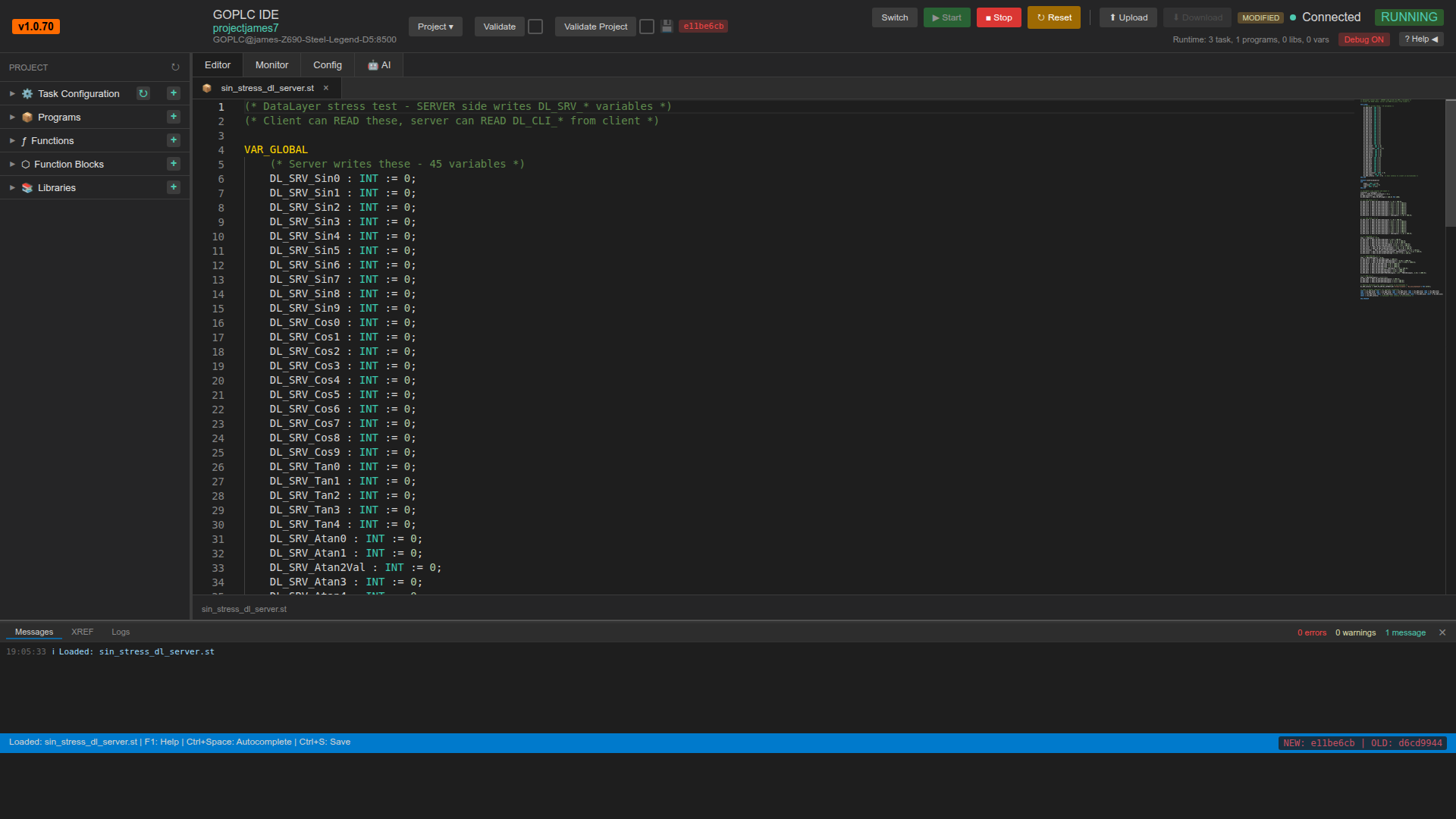
Web-Based IDE
Monaco editor with IEC 61131-3 syntax highlighting, autocomplete, and live error detection. No software to install.
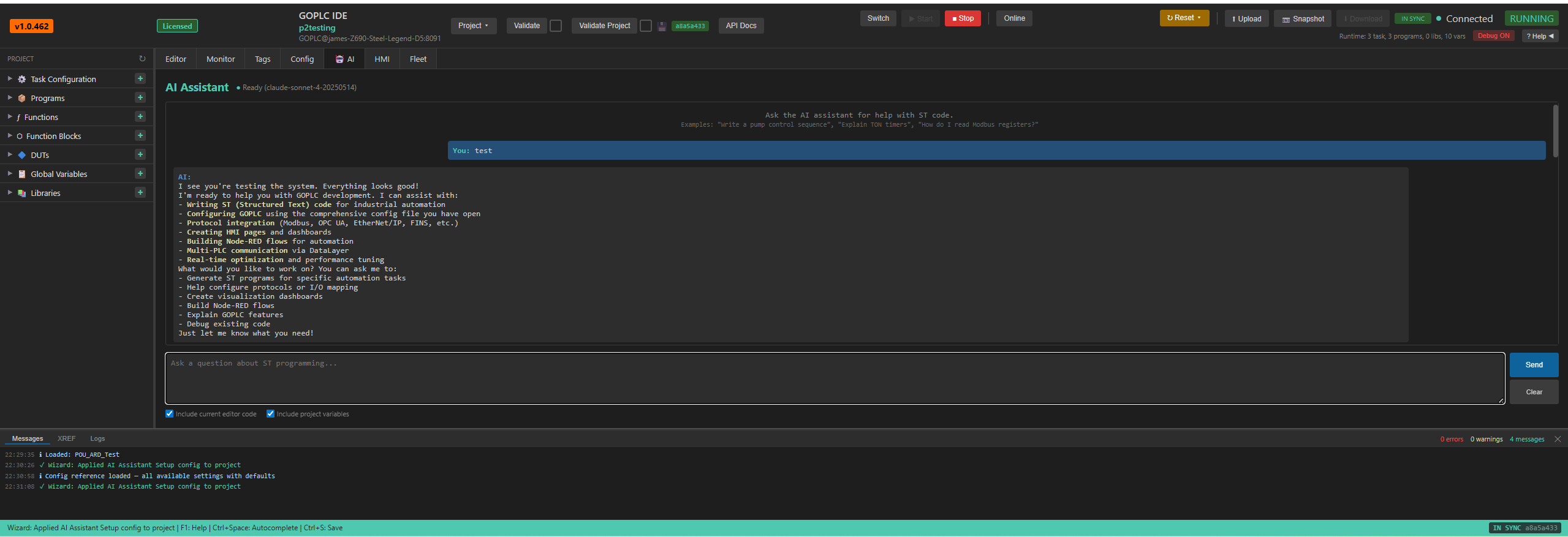
AI-Agentic Control
Native Claude, OpenAI, and Ollama integration. AI writes your ST code, generates HMI pages, and runs autonomous control loops.
Boss/Minion Clustering
Scale from 1 to 10,000+ instances. 620,000+ aggregate scans/sec. One $70K server replaces $600K-$15M in traditional PLCs.
25+ Protocol Drivers
Modbus, EtherNet/IP, OPC UA, BACnet, DNP3, MQTT, NATS, ZMQ, Sparkplug B, IEC 104, ctrlX EtherCAT, S7, PROFINET, FINS, SNMP, and more.
Step Debugger
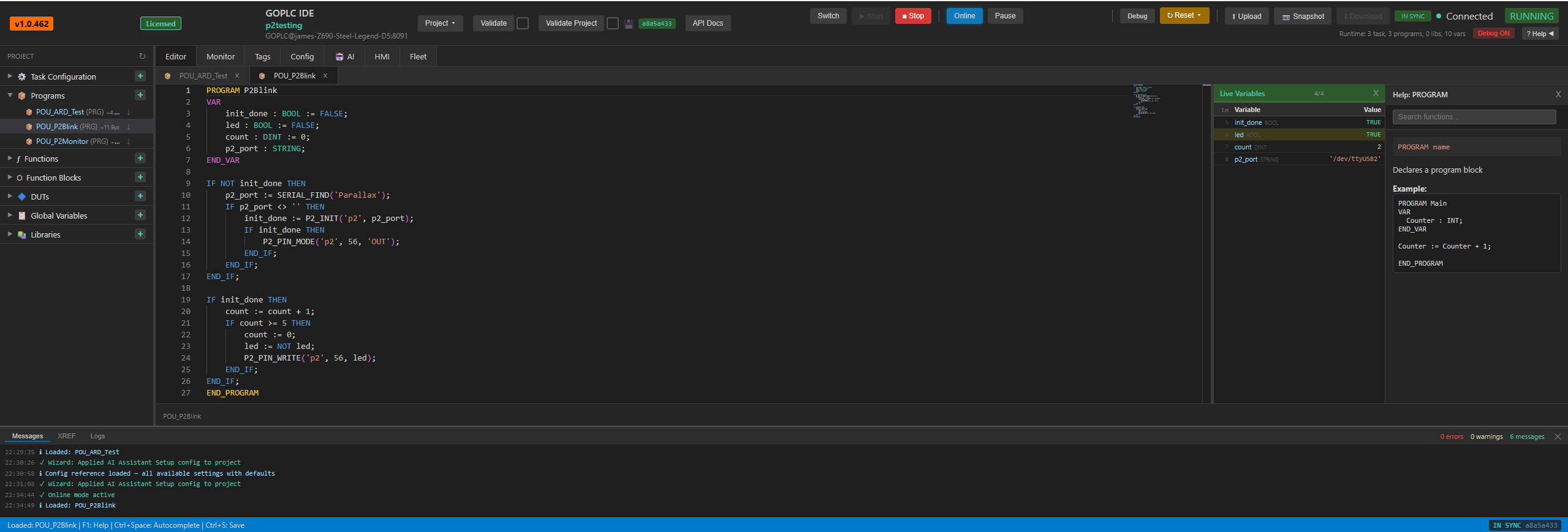
Breakpoints, step into/over/out, call stack inspection, and live variable modification. Software-grade debugging in a browser.
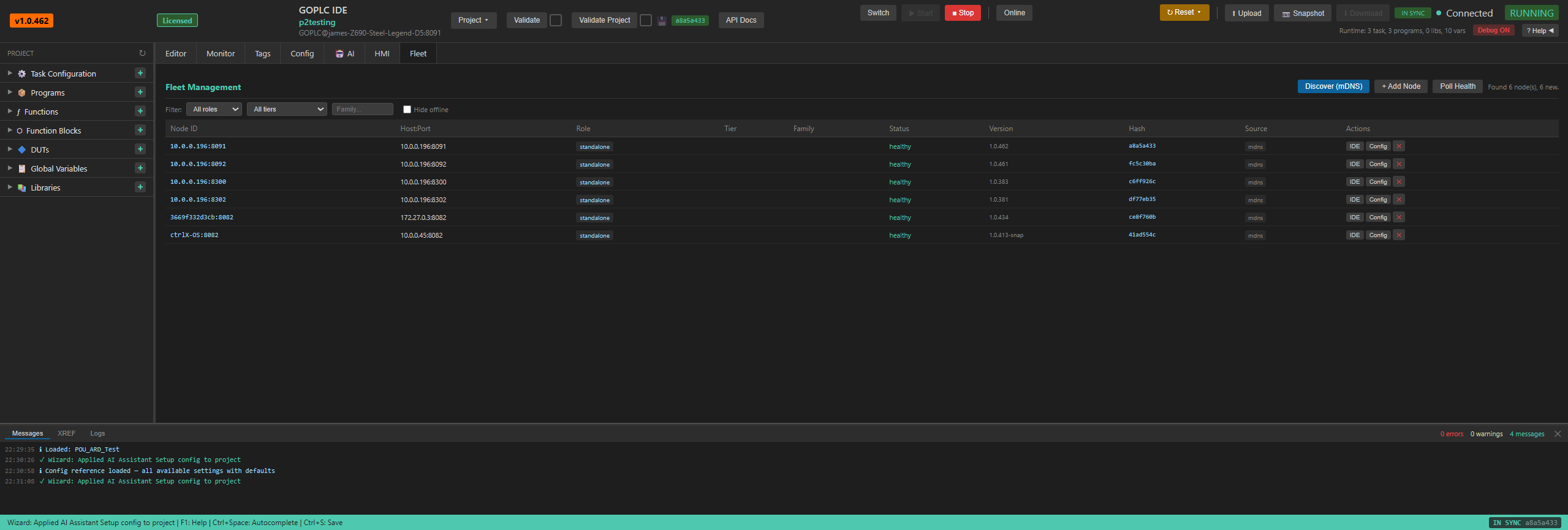
Fleet Management
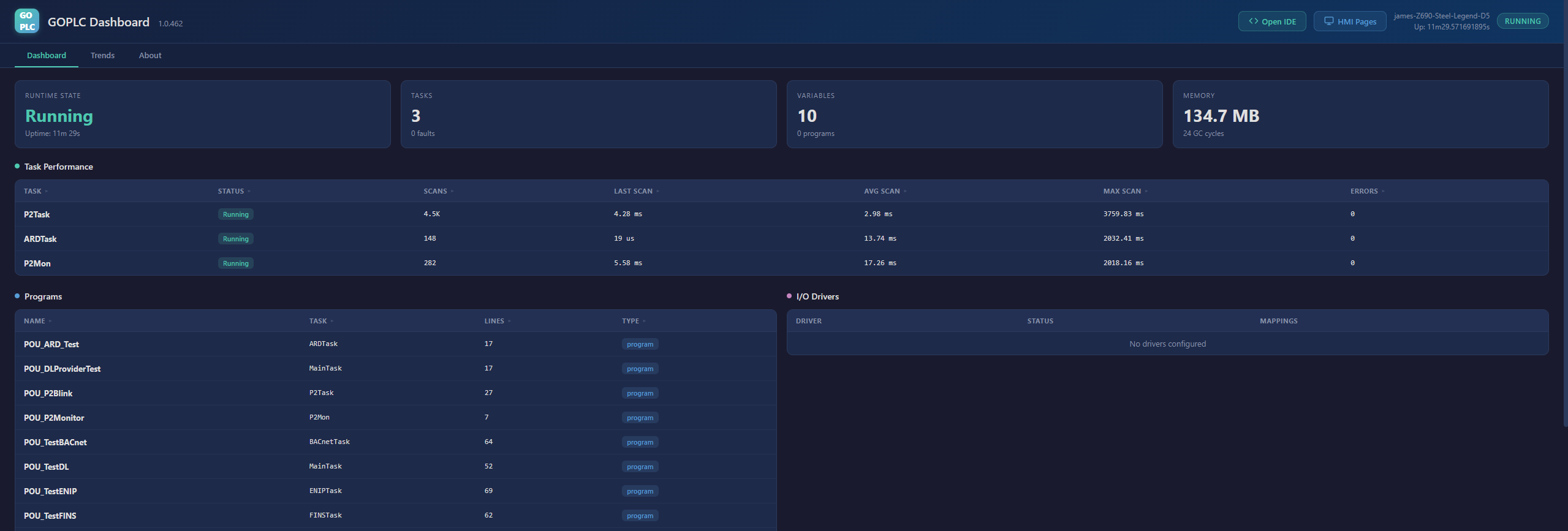
Centralized monitoring and control across all deployments. Multi-site visibility, health monitoring, and fleet-wide configuration management.
See It in Action
A real IDE, a real debugger, real AI — all running in your browser
How GOPLC Compares
Modern architecture vs. legacy industrial control
| Capability | GOPLC | Allen-Bradley | Siemens | Beckhoff |
|---|---|---|---|---|
| Min. Scan Time | 20-50 µs | 500 µs | 250 µs | 50 µs |
| CPU Cores | Unlimited (clustered) | 1 | 1-2 | 4-8 |
| Aggregate Scans/sec | 620,000+ | ~2,000 | ~4,000 | ~20,000 |
| AI Integration | Native — 3 providers, 12 tools | None | None | None |
| Clustering | 10,000+ instances | None | None | None |
| Web IDE | Built-in (Monaco) | Studio 5000 (~$5K) | TIA Portal (~$4K) | TwinCAT (Free) |
| Protocol Drivers | 25+ native | EtherNet/IP only | PROFINET + add-ons | EtherCAT + add-ons |
| Built-in Functions | 2,200+ | ~200 | ~300 | ~400 |
| Deployment | Docker, Snap, Bare Metal | Proprietary hardware | Proprietary hardware | Windows IPC |
Built for Real-World Industrial Applications
From protocol gateways to enterprise-scale distributed control
Protocol Gateway
Bridge Modbus, BACnet, DNP3, OPC UA, and MQTT in a single runtime. Replace racks of protocol converters with one GOPLC instance.
Edge Controller
Run on ARM64 edge devices or Bosch ctrlX CORE. Full PLC capability at the edge with cloud connectivity via MQTT and OPC UA.
Data Center BMS
Three-tier architecture for data center monitoring and control. 12 native protocols cover every device from UPS to CRAC units.
Water & Wastewater
Distributed pump station control with DNP3 store-and-forward for unreliable WAN links. Zero data loss with dual-path redundancy.
Building Automation
BACnet/IP and MSTP with COV subscriptions and priority arrays. HVAC, lighting, and energy management in one runtime.
Test & Simulation
Spin up hundreds of virtual PLCs for testing. Simulate entire plant floors. Perfect for commissioning, training, and development.
One Server Replaces
a Room Full of PLCs
GOPLC's clustering architecture means a single server can run thousands of PLC instances. The math is simple: one $70K server replaces $600K to $15M in traditional programmable controllers.
Interesting Reading
Technical whitepapers exploring GOPLC's architecture and real-world performance data
Distributed Real-Time PLC Performance
Boss/minion clustering architecture. 10.4x throughput improvement. 620,949 aggregate scans/sec across 31 cores.
Universal Protocol Gateway for Data Centers
Three-tier data center architecture. 12 native protocols. Dual-path redundancy with zero data loss.
DC Simulation: Hardware Gateway Architecture
11 device simulators, 6 gateway blueprints, 50MW to 1GW scale. ctrlX CORE deployment with cost modeling.
Ready to Modernize Your Automation?
Stop paying tens of thousands per controller. Stop being locked into proprietary ecosystems. Start building with a PLC runtime designed for the future.